CAYMAN DRAMA SOCIETY A classic story is faithfully
About the article
This is a digitised version of an article from The Cayman Compass's print archive. Occasionally, the digitisation process introduces transcription errors, or other problems.
See the article in its original context from February 2004.
Brought to you by

With the intention of congratulating some of them on their children's performance, she approached one man she knew and told him, "Your daughter was really very good." "Very good?" the father roared back. "She was GREAT!"
Such loyalty is understandable, but intimidating. It takes an intrepid and particularly clever writer to review any production involving children in prominent roles. When seven young performers are featured, the task is even more daunting.
Fortunately, in the case of the Cayman Drama Society's current offering, Anne of Green Gables, commentary is relatively easy. More than two weeks before the play was to begin its run, the three boys and four girls in the cast were line perfect. With typical pre-teen energy and singlemindedness, they then bombarded director Pat Steward with questions about their props and costumes.
Last weekend, they won the performer's prize - a standing ovation on opening night.
The play's storyline, from the well-loved book by Lucy Maud Montgomery, covers four years. The time span could have been a problem. When girls of 12 put up their hair and don formal party dresses, it is easy to envisage them as 16-year-olds. When boys of 12 dress up, they tend to look like, well, 12-year-olds.
Ah, but that is where the acting comes in. The boys modulate the pace of their delivery, they move more smoothly, they show an appreciation of girls beyond classroom teasing.
In the play's running time of two and a half hours, the boys mature almost before our eyes.
They and the girls have become the characters, FROM PAGE 8 projecting their personalities consistently and believably.
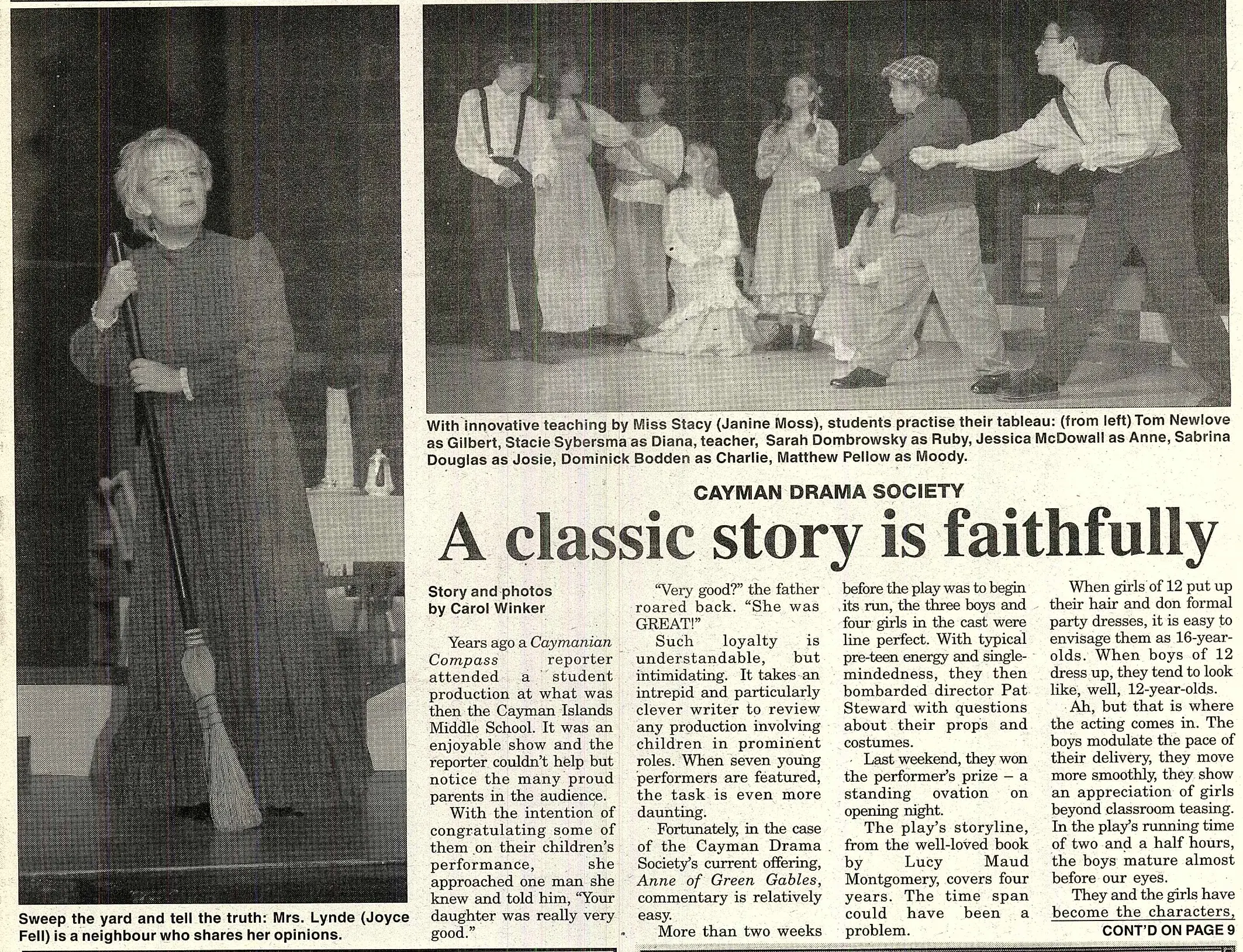
Taking the roles of Anne's friends and classmates are Stacie Sybersma, Thomas Newlove, Sabrina Douglas, Sarah Dombrowsky, Dominick Bodden and Matthew Pellow. Special mention must be made of Anne herself, played by Jessica McDowall.
Not only is Anne on stage more than anyone else in the play, she is also the catalyst for other characters' actions and reactions. If audiences dislike Anne - or worse, feel noncommittal about her - the play loses focus. Fortunately, Jessica's Anne is just the right combination of awkwardness and earnestness, imagination and practicality, bad temper and affection.
The adults are noteworthy characters, too - some more dimensional than others. Louise Rigdon and Bill Bewley are Marilla and Mathew Cuthbert, the brother and sister who take Anne into their home. Shy Matthew has promised to leave Anne's upbringing to Marilla, so it's interesting to note what crises prompt him to speak up.
Apart from Anne herself, Marilla is the person who undergoes the most emotional transformation.
The play develops almost as a series of vignettes, with neighbour Mrs. Lynde (played by Joyce Fell) occasionally serving as narrator to bridge scenes. Anyone not familiar with the books will appreciate the programme notes put together by director Pat Steward and producer Phil Pace.