LOVERS AT VERSAILLES A tale of wrong lyrics and love just in time
About the article
This is a digitised version of an article from The Cayman Compass's print archive. Occasionally, the digitisation process introduces transcription errors, or other problems.
See the article in its original context from July 2003.
Brought to you by

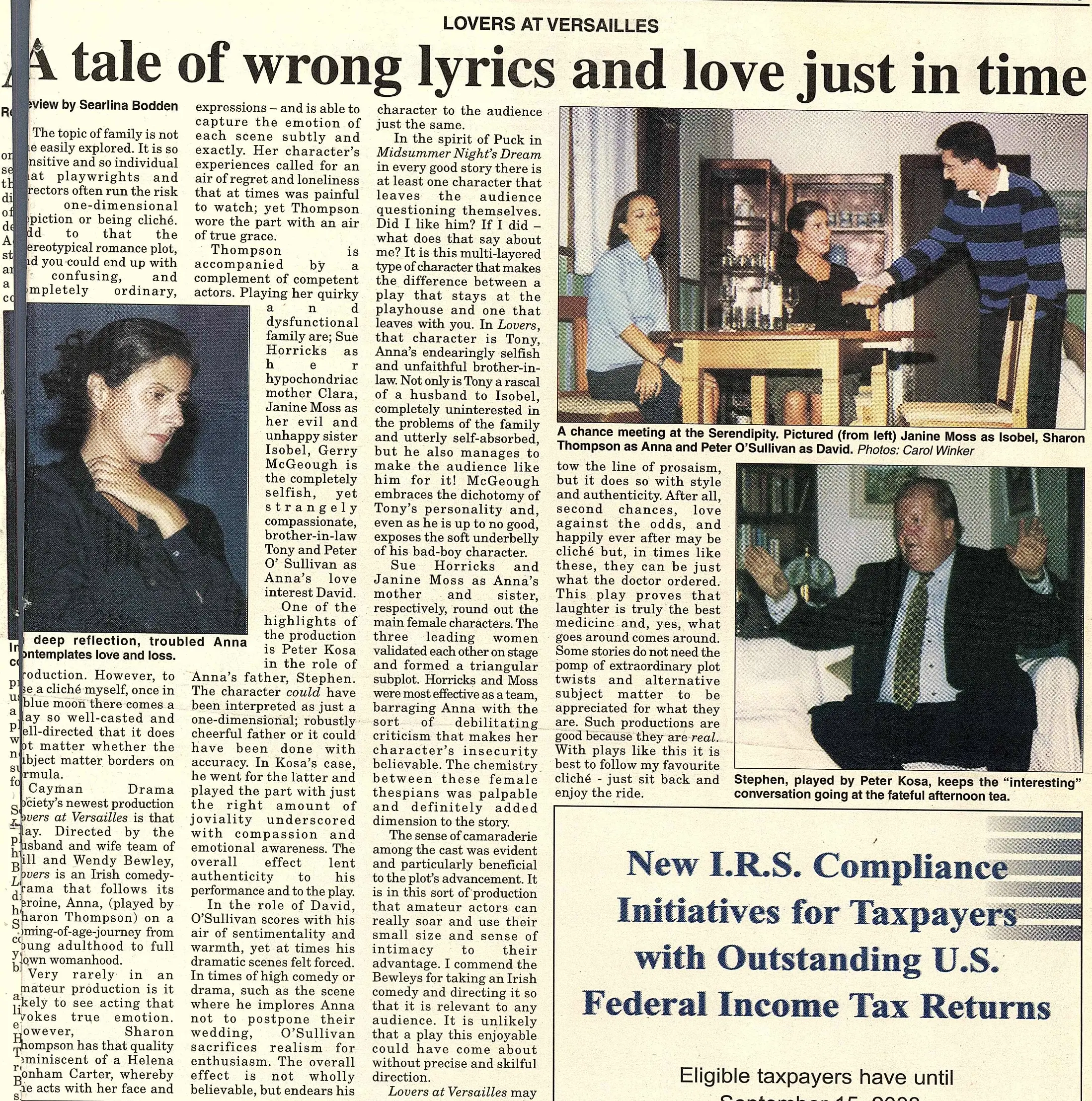
dd to that the stereotypical romance plot, nd you could end up with confusing, and completely ordinary, production. However, to use a cliché myself, once in a blue moon there comes a play so well-casted and well-directed that it does not matter whether the subject matter borders on formula.
Cayman Drama Society's newest production Lovers at Versailles is that play. Directed by the husband and wife team of Bill and Wendy Bewley, Lovers is an Irish comedy-drama that follows its heroine, Anna, (played by Sharon Thompson) on a coming-of-age-journey from young adulthood to full grown womanhood.
Very rarely in an amateur production is it likely to see acting that evokes true emotion. However, Sharon Thompson has that quality reminiscent of a Helena Bonham Carter, whereby she acts with her face and expressions—and is able to capture the emotion of each scene subtly and exactly. Her character's experiences called for an air of regret and loneliness that at times was painful to watch; yet Thompson wore the part with an air of true grace.
Thompson is accompanied by a complement of competent actors. Playing her quirky dysfunctional family are; Sue Horricks as led Anna hypochondriac mother Clara, Janine Moss as her evil and unhappy sister Isobel, Gerry McGeough is the completely selfish, yet strangely compassionate, brother-in-law Tony and Peter O' Sullivan as Anna's love interest David. One of the highlights of the production is Peter Kosa in the role of Anna's father, Stephen.
The character could have been interpreted as just a one-dimensional; robustly cheerful father or it could have been done with accuracy. In Kosa's case, he went for the latter and played the part with just the right amount of joviality underscored with compassion and emotional awareness. The overall effect lent authenticity to his performance and to the play. In the role of David, O'Sullivan scores with his air of sentimentality and warmth, yet at times his dramatic scenes felt forced. In times of high comedy or drama, such as the scene where he implores Anna not to postpone their wedding, O'Sullivan sacrifices realism for enthusiasm. The overall effect is not wholly believable, but endears his character to the audience just the same.
In the spirit of Puck in Midsummer Night's Dream in every good story there is at least one character that leaves the audience questioning themselves. Did I like him? If I did what does that say about me? It is this multi-layered type of character that makes the difference between a play that stays at the playhouse and one that leaves with you. In Lovers, that character is Tony, Anna's endearingly selfish and unfaithful brother-in-law. Not only is Tony a rascal of a husband to Isobel, completely uninterested in the problems of the family and utterly self-absorbed, but he also manages to make the audience like him for it! McGeough embraces the dichotomy of Tony's personality and, even as he is up to no good, exposes the soft underbelly of his bad-boy character.
Sue Horricks and Janine Moss as Anna's mother and sister, respectively, round out the main female characters. The three leading women validated each other on stage and formed a triangular subplot. Horricks and Moss were most effective as a team, barraging Anna with the sort of debilitating criticism that makes her character's insecurity believable. The chemistry between these female thespians was palpable and definitely added dimension to the story.
The sense of camaraderie among the cast was evident and particularly beneficial to the plot's advancement. It is in this sort of production that amateur actors can really soar and use their small size and sense of intimacy to their advantage. I commend the Bewleys for taking an Irish comedy and directing it so that it is relevant to any audience. It is unlikely that a play this enjoyable could have come about without precise and skilful direction.
Lovers at Versailles may tow the line of prosaism, but it does so with style and authenticity. After all, second chances, love against the odds, and happily ever after may be cliché but, in times like these, they can be just what the doctor ordered.
This play proves that laughter is truly the best medicine and, yes, what goes around comes around.
Some stories do not need the pomp of extraordinary plot twists and alternative subject matter to be appreciated for what they are. Such productions are good because they are real. With plays like this it is best to follow my favourite cliché - just sit back and enjoy the ride.