First requisites
About the article
This is a digitised version of an article from The Cayman Compass's print archive. Occasionally, the digitisation process introduces transcription errors, or other problems.
See the article in its original context from March 2003.
Brought to you by

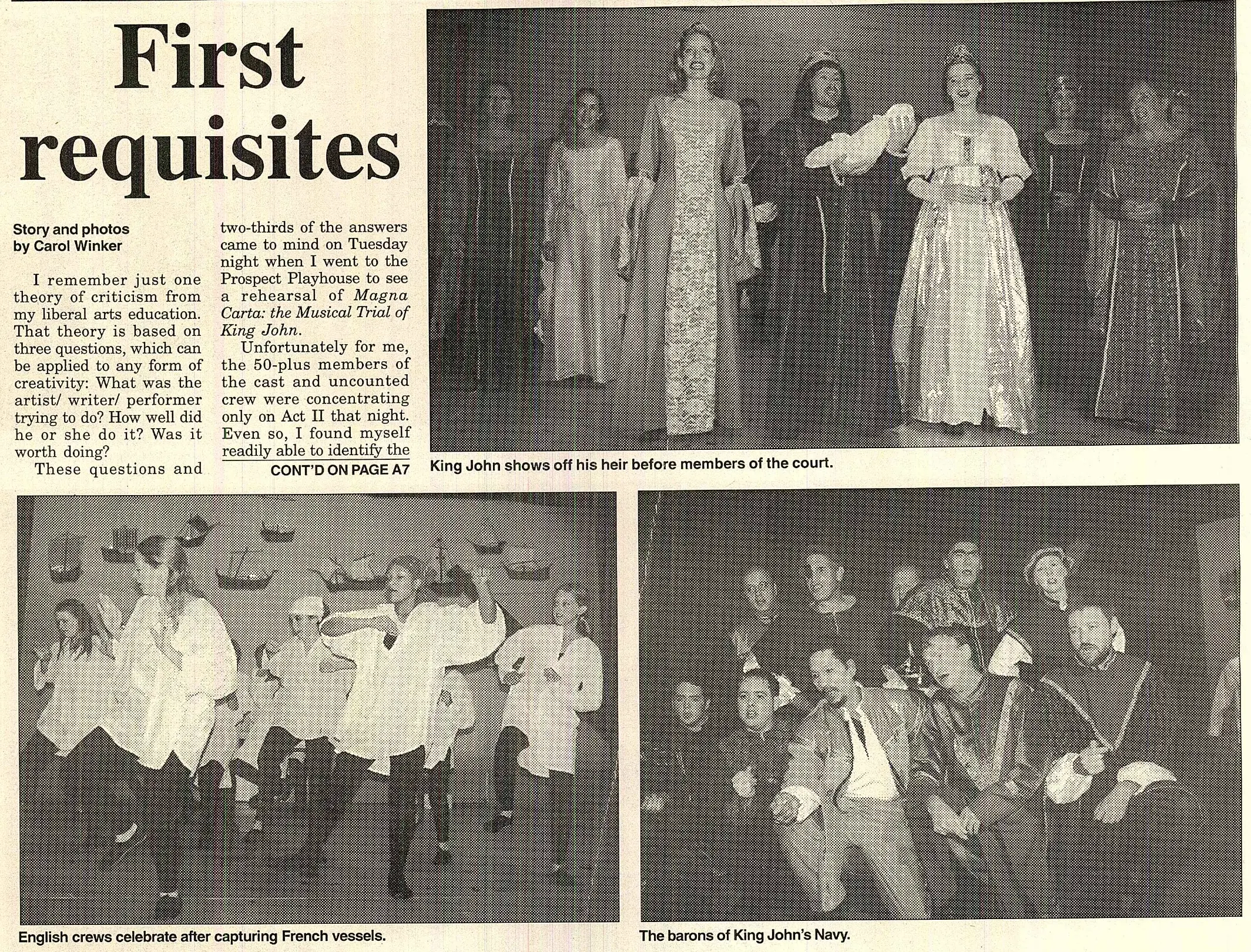
These questions and two-thirds of the answers came to mind on Tuesday night when I went to the Prospect Playhouse to see a rehearsal of Magna Carta: the Musical Trial of King John.
Unfortunately for me, the 50-plus members of the cast and uncounted crew were concentrating only on Act II that night. Even so, I found myself readily able to identify the CONT'D ON PAGE A7 CONT'D FROM PAGE A4 main numerous main characters.
Keeping track of several past and present queens, a variety of countesses and all the king's barons was easy, I suspect, because they were portrayed by familiar actors who gave strong personalities to little-known names.
In fact, playwright/director Colin Wilson revealed, cast members told him they had gone on the Internet to look up their characters and learn more about them.
Characters from a locally written play appearing on the Internet? Yes, because every person in Magna Carta is someone whose existence and relative importance can be historically documented.
As is generally known, Magna Carta means "Great Charter" a charter of liberties granted by King John in England eight centuries ago. One concept that seems so basic to us now was an astonishing concession by the monarch then: that no freedman should be imprisoned or dispossessed of his property except by the lawful judgment of his peers or by the law of the land.
Colin Wilson saw the Magna Carta as a milestone in British history and therefore a significant part of Cayman's background. He decided to write a play that would present the taken-for-granted ideas and half-forgotten personages in a way that would bring both to life for today's audiences.
Life means energy and movement. Logical vehicles for conveying these are song and dance. So Colin talked his ideas over with Chuck and Barrie Quappé, the husband-wife team that has been performing, writing and producing songs for two decades. They took on the challenge of writing all the music and lyrics for the play.
I admire what Colin, Chuck, Barrie, the cast and crew are trying to do. Is it worth doing? It's certainly preferable in this Quincentennial year for the Cayman Drama Society to try something above a typical pantomime or farce however well done.
Only the second critical question remains. Audiences will be able to provide that answer every Thursday, Friday and Saturday until 3 May, except the Easter weekend. The box office number is 949-5054.