Seven things to know about Lughnasa
About the article
This is a digitised version of an article from The Cayman Compass's print archive. Occasionally, the digitisation process introduces transcription errors, or other problems.
See the article in its original context from April 2002.
Brought to you by

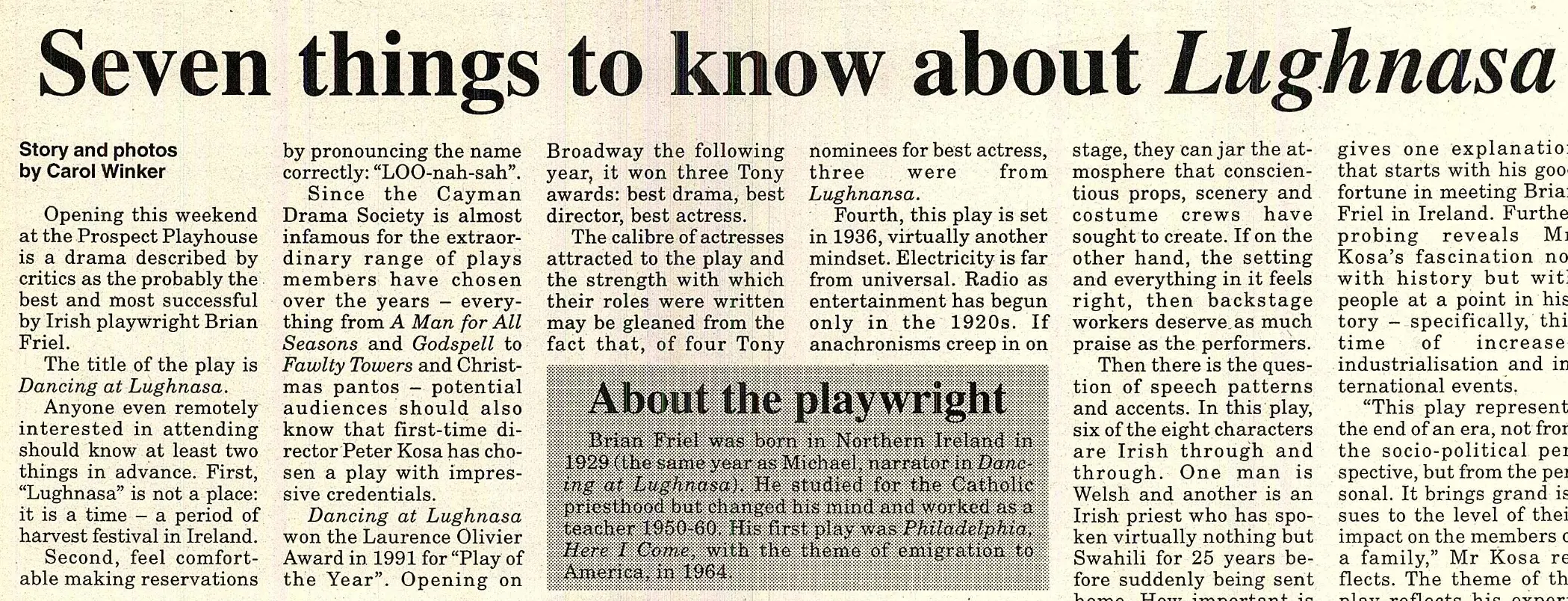
The title of the play is Dancing at Lughnasa.
Anyone even remotely interested in attending should know at least two things in advance. First, "Lughnasa" is not a place: it is a time - a period of harvest festival in Ireland. Second, feel comfortable making reservations by pronouncing the name correctly: "LOO-nah-sah".
Since the Cayman Drama Society is almost infamous for the extraordinary range of plays members have chosen over the years - everything from A Man for All Seasons and Godspell to Fawlty Towers and Christmas pantos - potential audiences should also know that first-time director Peter Kosa has chosen a play with impressive credentials.
Dancing at Lughnasa won the Laurence Olivier Award in 1991 for "Play of the Year". Opening on Broadway the following year, it won three Tony awards: best drama, best director, best actress.
The calibre of actresses attracted to the play and the strength with which their roles were written may be gleaned from the fact that, of four Tony nominees for best actress, three were from Lughnansa.
Fourth, this play is set in 1936, virtually another mindset. Electricity is far from universal. Radio as entertainment has begun only in the 1920s. If anachronisms creep in on stage, they can jar the atmosphere that conscientious props, scenery and costume crews have sought to create. If on the other hand, the setting and everything in it feels right, then backstage workers deserve as much praise as the performers.
Then there is the question of speech patterns and accents. In this play, six of the eight characters are Irish through and through. One man is Welsh and another is an Irish priest who has spoken virtually nothing but Swahili for 25 years before suddenly being sent home. How important is the authenticity of everyone's accent?
One simple answer is that authentic speech does not necessarily make great theatre. The speech must be understood by most of the audience. The second and complementary answer is that, especially in amateur productions, if the accents have a bit of flavour without jarring the ear, they are probably all right.
Given all the challenges, one might readily wonder why Peter Kosa has chosen this play for his debut. His message in the show programme gives one explanation that starts with his good fortune in meeting Brian Friel in Ireland. Further probing reveals Mr. Kosa's fascination not with history but with people at a point in history-specifically, this time of increased industrialisation and international events.
"This play represents the end of an era, not from the socio-political perspective, but from the personal. It brings grand issues to the level of their impact on the members of a family," Mr Kosa reflects. The theme of the play reflects his experience in Cayman through association with the National Drug Council. Major exterior forces are having a big effect on families here, he says.
A worthy theme, "terrific story" and "great entertainment" give him all the motivation he needs. Finally, having come this far, the reader should know how to make reservations. Since the play runs Thursday, Friday and Saturday through 4 May, simply pick the date and phone 949-5054. Tickets are $15 for adults, $10 for ages under18. Curtain is 7.30 pm.