Thanks, CDS, for thirty years of theatre
About the article
This is a digitised version of an article from The Cayman Compass's print archive. Occasionally, the digitisation process introduces transcription errors, or other problems.
See the article in its original context from February 2001.
Brought to you by

Although actors are known to love the spotlight and directors expect to be listened to, CDS members that night were simply being themselves and nobody sought any special attention. They were too modest.
But one "prop" spoke for them, more eloquently than any tributes or accolades. Prepared by CDS member Penny Phillips, it was simply a list of years and the plays produced since the society started. According to this record, the total is 116.
One hundred and sixteen productions. From classic drama to bedroom farce, Broadway musicals to Shakespeare, traditional pantomimes, original scripts and adaptations. There isn't much the Cayman Drama Society has not attempted over the years.
Yes, they were keeping themselves amused and occupied, especially in the days before these Islands had radio or television. But through three decades they have also entertained thousands of people whose exposure to live theatre would otherwise have been limited or, at times, non-existent. Moreover, members have never been paid even five cents for their work: all profits have gone toward building funds, theatre maintenance and improvement; in recent years an education trust has been added.
There have been other theatre groups before and since. A proper cultural retrospect will someday recognise the role of community, church and school groups that entertained people over the years. The Bodden Town Players was one such notable group.
The late 1970s saw the formation of the Inn Theatre Company, which achieved some amazing results in a small room at the old Royal Palms Hotel. It was so successful, in fact, that it became the Cayman National Theatre Company, which has since metamorphosed into the Cayman National Cultural Foundation.
Looking at the history of the Cayman Drama Society detracts not a whit from the accomplishments and contributions of any other organisation.
The following material is based on articles in the Caymanian Compass, its predecessor The Caymanian Weekly, Norwester magazine, a brief history of CDS prepared for the Ministry of Culture a few years back, and this writer's own observations.
1970s
"By Popular Request An Encore Performance 'See How They Run' Will be given at the town hall, George Town On Saturday next... Tickets J$2, J$1.50 or J$1" The above notice appeared in The Caymanian Weekly newspaper on 19 November 1970.
Just above it was a brief article which started: "The Cayman Drama Society CONT'D ON PAGE A12 FROM PAGE A11 staged their first production last week and showed that, whilst their subject was a lighthearted comedy, they took the art of drama very seriously."
The rest of the five paragraphs saluted all participants, but named only Val Morgan for her characterisation of the "outraged spinster". Writer "L.D." added that the Saturday show was a sellout, "despite heavy rain and thunder".
There are no known records of how much money was made or spent on the production. [As an aside, readers may be intrigued to know that Cayman's currency was the Jamaican dollar. By way of price comparison, a head of lettuce cost 30 cents; admission to a "big dance" at the Lighthouse Club was 50 cents; a nursery sold "rose plants" for J$4.]
Audience response to that first effort obviously encouraged the group to continue.
It had started when a few people got together socially to discuss the possibility of putting on the play. They included Valarie and John Morgan, Stanley Panton, and John Maples among others. During rehearsals, others joined in. Among them were Peter Phillips and John Furze.
While planning their second play, they also decided to organise formally. They drew up a memorandum and articles of association and, in April 1971, registered the Cayman Drama Society as a Cayman company limited by guarantee. The society then applied to be registered as a not-forprofit association.
Members of that first committee were Mr. Panton as chairman; Maureen Moody, deputy chairman; John K. Shield, treasurer; John G. Morgan, secretary; John Furze, Valarie Morgan and John Maples. Also in April, CDS raised the curtain on "the most hilarious group of amateur actors you've ever seen together in one production". This quote comes from an article that started on The Caymanian Weekly's front page. The play was Doctor in the House.
This time the reviewer was anonymous but no less effusive. He or she also commented on the actors by name: Stuart Hurst, Colin Medhurst, Ken Morgan and Keith Ball were praised for "darned-good-acting" along with Gloria Myers, Lionel Downer, Allyson Alberga, Hazel Mackenzie. The play ran one week, Wednesday through Saturday, again at the Town Hall.
By December 1971, CDS had around 55 members. With the best dramatic instinct, they explored a different genre for their third production - the well-received "thriller" Wait Until Dark. Over the next three years, they reached their goal of presenting three plays per year. Almost every production could be considered a first of some kind: Love's a Luxury was carried to Cayman Brac High School in 1973; Johnny Belinda was performed at the new Cinema on West Bay Road.
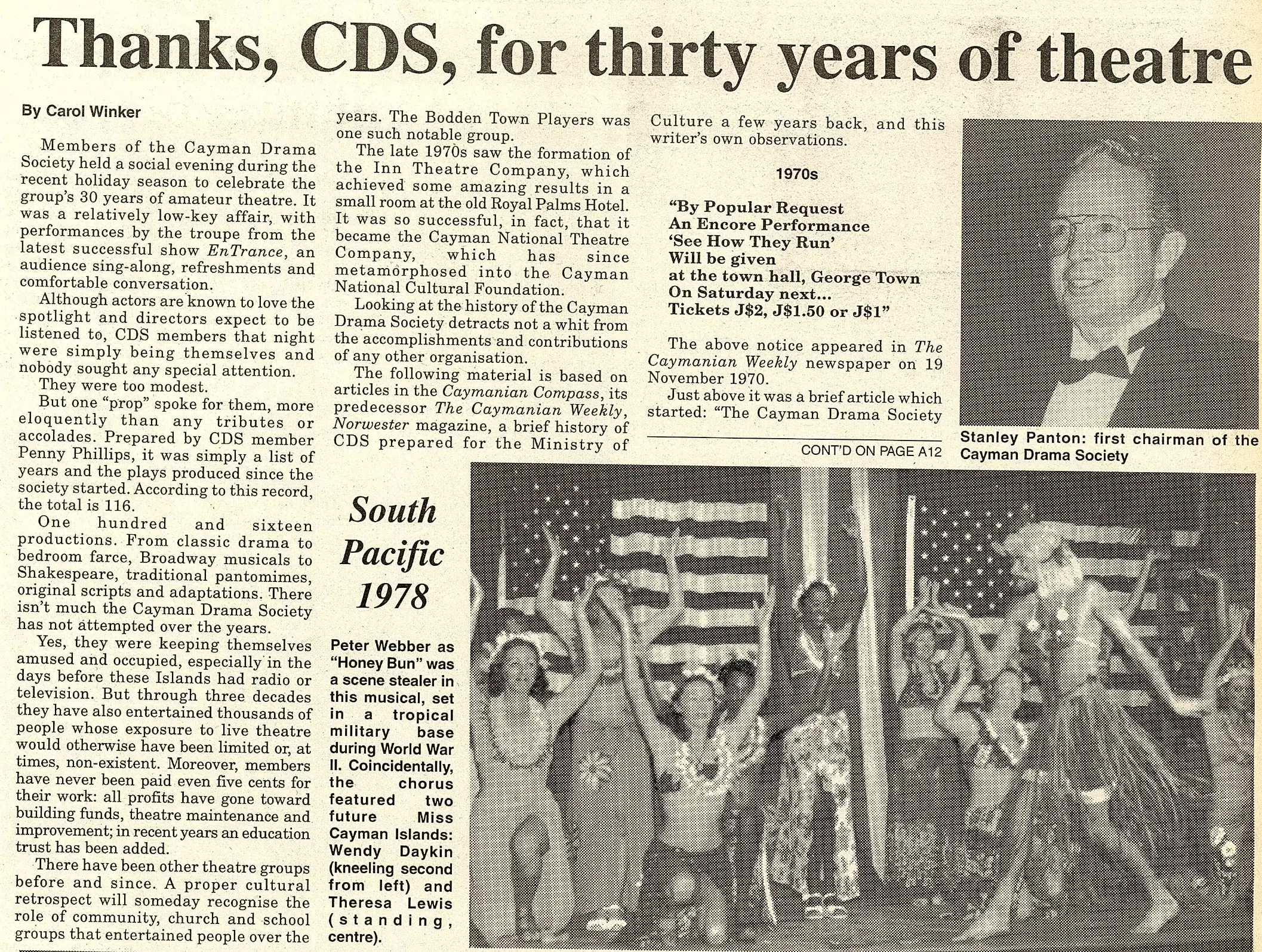
But GT Town Hall was still home venue. In 1975 there were only two plays, but again, both were popular with audiences – Arsenic and Old Lace and The Hostage. The following year, CDs got together with the Cayman singers for The Boyfriend. Every production was noteworthy in some respect, but in 1978 members outdid themselves, not only in quantity but quality. First there was the remarkable South Pacific. Little stages were built to each side of the main stage and the Town Hall was transformed. The cast was large in size, enormous in talent, and set the standards for musical productions ever since.
No less impressive was the next production: A Man for All Seasons, full of pageantry and historical drama. Star Spangled Girl starred the reigning Miss Cayman (Patricia Jackson-Patino). The group continued with Love Is... at the Royal Palms Hotel, and, at various venues, Parrots Review for a Pirates Week in its infancy.
By the end of its first decade, CDS was a veteran theatre group, with 27 different productions to its credit.
1980s
Since its inception, CDS had as one of its goals, "To obtain by licence, lease or purchase the use of land, building and equipment for the exhibition to the public on payment or otherwise of dramatic and other forms of artistic entertainment".
In May 1979, it was announced that the Racquet Club had offered CDS a piece of land at a peppercorn rent of CI$1 per year for 20 years, with an option to buy. The then building committee pledged its full support. In April 1980, another newsletter reported good progress.
However, later in 1980, it was learned that the Racquet Club was for sale. Not sure what the legal situation would be with a new owner, it was agreed that CDS would withdraw from the deal. All parties were apparently amicable: the society was reimbursed $4,000 for marl fill already on the site.
In 1981, with Bill Bazelmans as CDS chairman, another site was offered at a peppercorn rent for 50 years. This came about because Bill and his business associate Arni Sumarlidason owned the Cayman Foods land and building [currently being rebuilt for the Red Bay Primary and Lighthouse Schools] in Prospect. The westernmost portion of the land was totally undeveloped; the offer was gratefully accepted.
By that time, fundraising and productions had enabled CDS to put $45,000 into the building project. The foundation was laid, a steel frame and roof erected. Then the money ran out.
One reason, according to the CDS history, was the announcement in 1981 that the Inn Theatre Company would be building a complex off West Bay Road, using funds donated by Mrs. Helen Harquail. "This had the effect of totally drying up any source of funds from fundraising activities, as no one could understand why Grand Cayman would need two theatres," CDS summarised. "Thus no further work was carried out and the site was left to become overgrown and inaccessible." While the building project ground to a halt, CONT'D ON FACING PAGE