Audiences hail CDS' The King and I:
About the article
This is a digitised version of an article from The Cayman Compass's print archive. Occasionally, the digitisation process introduces transcription errors, or other problems.
See the article in its original context from November 1998.
Brought to you by

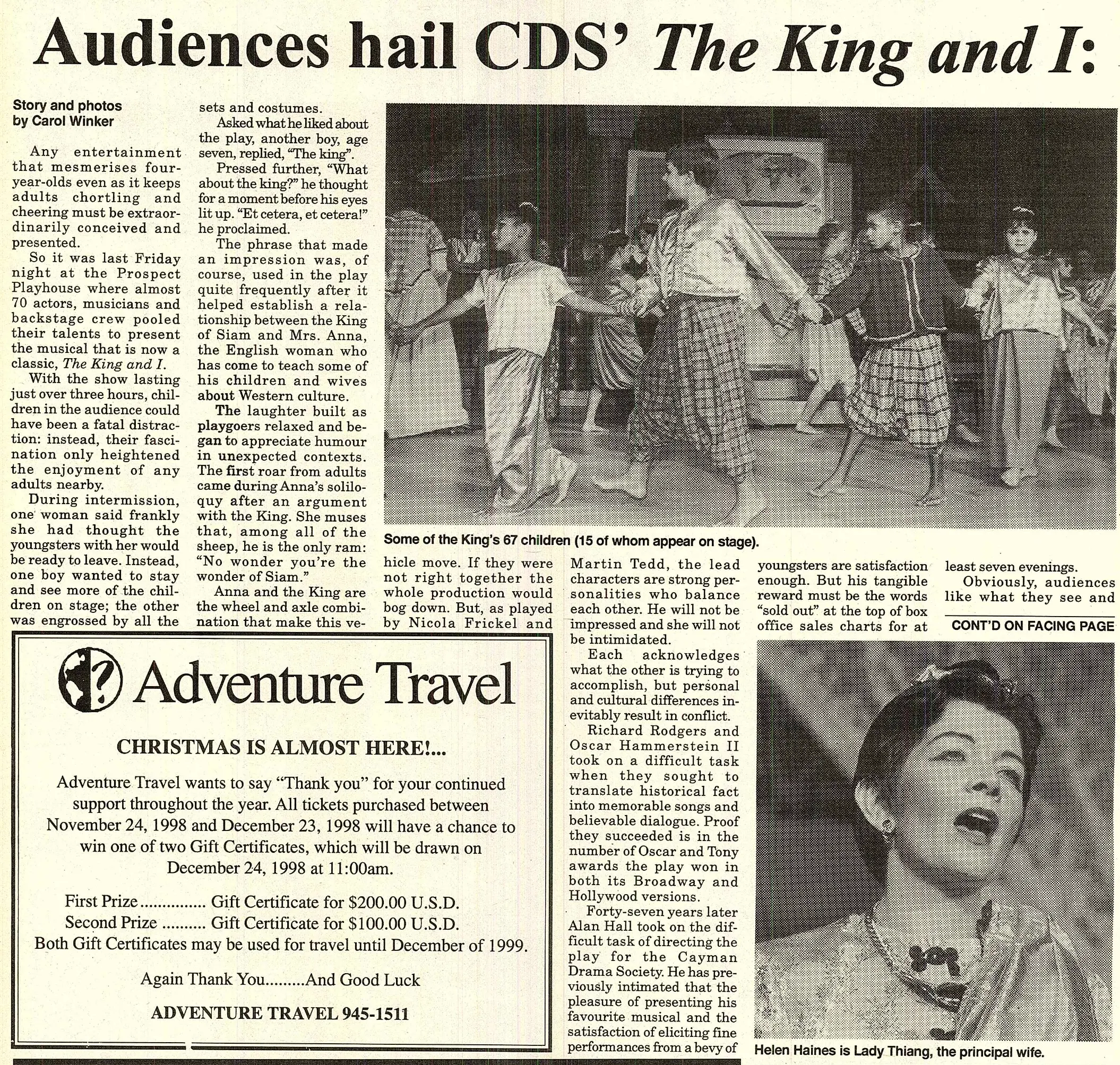
So it was last Friday night at the Prospect Playhouse where almost 70 actors, musicians and backstage crew pooled their talents to present the musical that is now a classic, The King and I. With the show lasting just over three hours, children in the audience could have been a fatal distraction: instead, their fascination only heightened the enjoyment of any adults nearby.
During intermission, one woman said frankly she had thought the youngsters with her would be ready to leave. Instead, one boy wanted to stay and see more of the children on stage; the other was engrossed by all the sets and costumes.
Asked what he liked about the play, another boy, age seven, replied, "The king". Pressed further, "What about the king?" he thought for a moment before his eyes lit up. "Et cetera, et cetera!" he proclaimed.
The phrase that made an impression was, of course, used in the play quite frequently after it helped establish a relationship between the King of Siam and Mrs. Anna, the English woman who has come to teach some of his children and wives about Western culture.
The laughter built as playgoers relaxed and began to appreciate humour in unexpected contexts. The first roar from adults came during Anna's soliloquy after an argument with the King. She muses that, among all of the sheep, he is the only ram: "No wonder you're the wonder of Siam."
Anna and the King are the wheel and axle combination that make this vehicle move. If they were not right together the whole production would bog down. But, as played by Nicola Frickel and Martin Tedd, the lead characters are strong personalities who balance each other. He will not be impressed and she will not be intimidated.
Each acknowledges what the other is trying to accomplish, but personal and cultural differences inevitably result in conflict.
Richard Rodgers and Oscar Hammerstein II took on a difficult task when they sought to translate historical fact into memorable songs and believable dialogue. Proof they succeeded is in the number of Oscar and Tony awards the play won in both its Broadway and Hollywood versions.
Forty-seven years later Alan Hall took on the difficult task of directing the play for the Cayman Drama Society. He has previously intimated that the pleasure of presenting his favourite musical and the satisfaction of eliciting fine performances from a bevy of youngsters are satisfaction enough. But his tangible reward must be the words "sold out" at the top of box office sales charts for at least seven evenings.
Obviously, audiences like what they see and CONT'D ON FACING PAGE hear. Just as obviously, they are telling their friends. The result is that shows have been added for this Sunday and next, with a 6.00 pm curtain.
Last week, many of the people in attendance spoke knowledgeably of performances of The King and I which they had seen in other countries. Many aspects of Cayman's production compared favourably. "As good as amateur theatre anywhere," said several people. "Equal to an off-Broadway company," opined one woman. No show could earn such accolades if there were not strong support for the lead actors. And, in the case of a musical, no show could succeed without at least a few quality voices.
Too often, a so-called amateur theatre group is comprised of one- or two-dimension talents. People who can sing may not be able to act. People who can act can't dance. People who can sing, dance and act may be the wrong size or shape for a part.
As someone who occasionally writes about theatre, I admit to a personal preference for singers and I have a private standard by which I judge them. There are those for whom I find myself leaning forward, breathing with them and mentally encouraging them to make that high note or hold it for the appropriate emphasis.
Then there are the singers for whom I can sit back, relax and just let the melody flow. On that criterion, all singers were satisfactory to varying degrees. Three were outstanding: Helen Haines, as the King's principal wife; Rory Mann, as Anna's young son; and Anna herself. After one false note and the early loss of a note that should have been sustained, she warmed up to display a distinctive voice rich in harmonics. Breath control is another aspect of the task, since it is one thing to stand and deliver, quite another to romp around the stage in a cumbersome costume and still sing out with resonance, true pitch and convincing emotion.
Anna succeeds and it is only a matter of individual preference whether "Hello Young Lovers," "Shall We Dance," "Whistle a Happy Tune," "Getting to Know You" or "Shall I tell You "What I Think of You" is her crowning achievement. Ms. Haines' showpiece, "Something Wonderful", is not as familiar as the other songs, partly because the melody is not straightforward or instantly hum-able, written as it is in three sharps. It almost approaches aria form. But with her range and phrasing, Ms Haines is the diva who makes mastery seem so effortless.
The King has just one solo, which he delivers competently. "A Puzzlement" is written in the half-speaking, half-singing style made popular by Rex Harrison and Richard Burton.
The other three featured songs are romantic ballads which must carry the play's sub-plot simply because the dialogue skimps. Joanne Diaz-Berry and Stewart Moracen are the young lovers whose relationship is forbidden.
When Ms. Diaz-Berry sings "My Lord and Master" the audience is well aware how unwilling she is to have been given as a present to the King. He'll never know she loves another man and neither does the audience until