A story well and truly told
About the article
This is a digitised version of an article from The Cayman Compass's print archive. Occasionally, the digitisation process introduces transcription errors, or other problems.
See the article in its original context from November 1998.
Brought to you by

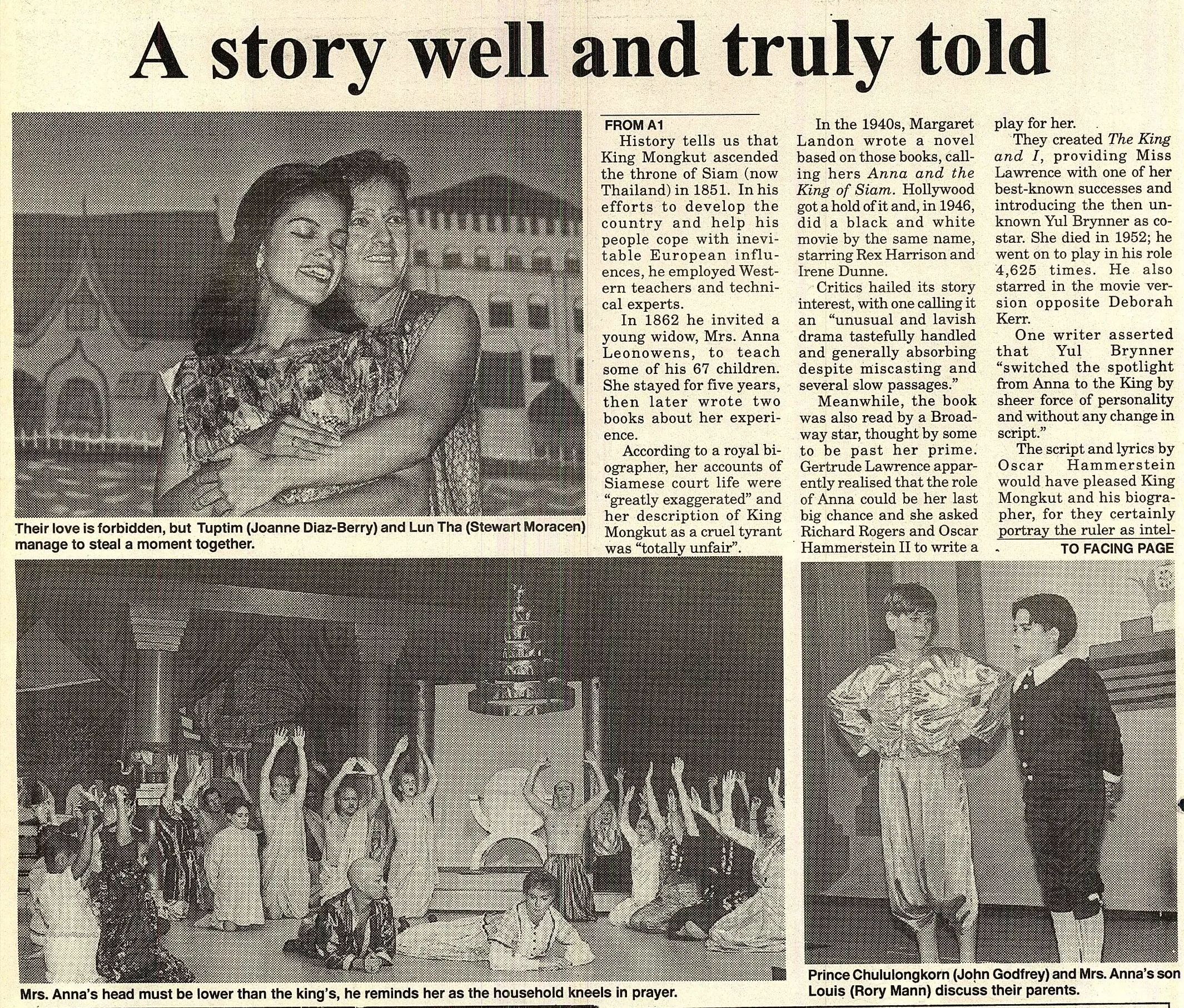
In 1862 he invited a young widow, Mrs. Anna Leonowens, to teach some of his 67 children. She stayed for five years, then later wrote two books about her experience.
According to a royal biographer, her accounts of Siamese court life were "greatly exaggerated" and her description of King Mongkut as a cruel tyrant was "totally unfair". In the 1940s, Margaret Landon wrote a novel based on those books, calling hers Anna and the King of Siam. Hollywood got a hold of it and, in 1946, did a black and white movie by the same name, starring Rex Harrison and Irene Dunne.
Critics hailed its story interest, with one calling it an "unusual and lavish drama tastefully handled and generally absorbing despite miscasting and several slow passages."
Meanwhile, the book was also read by a Broadway star, thought by some to be past her prime. Gertrude Lawrence apparently realised that the role of Anna could be her last big chance and she asked Richard Rogers and Oscar Hammerstein II to write a play for her.
They created The King and I, providing Miss Lawrence with one of her best-known successes and introducing the then unknown Yul Brynner as co-star. She died in 1952; he went on to play in his role 4,625 times. He also starred in the movie version opposite Deborah Kerr.
One writer asserted that Yul Brynner "switched the spotlight from Anna to the King by sheer force of personality and without any change in script."
The script and lyrics by Oscar Hammerstein would have pleased King Mongkut and his biographer, for they certainly portray the ruler as intel- TO FACING PAGE FROM FACING PAGE ligent, inquisitive, determined to do what he believes is right. If events did not occur exactly as the play shows them, nevertheless the essence of the man seems right. That is one truth.
Another is the balance between the king and Anna. If the king overwhelms everyone, or if the actor playing that role is so forceful, what is the source of any dramatic tension? The play was written precisely to show how two strong personalities can have the same goal and yet collide.
Here is the truth which, thankfully, the director and cast of the Cayman Drama Society have the vision and talents to present. As Nicola Frickel and Martin Tedd portray them, Anna and the King are both strong, principled, capable and determined people. They thrive on fresh ideas and challenges. They delight in word play. Listeners never know which will get the better of the other in any exchange.
Conflict inevitably arises from their backgrounds: East and West, Buddhist and Christian. He is a virtual dictator, however benevolent. She is accustomed to a monarch in a parliamentary democracy. Finally, and significantly, there is an undercurrent of their growing awareness of each other as man and woman.
The play as written rightly treats this aspect of their relationship with restraint. In the local production, it evolves with subtlety and only after mutual respect and a kind of friendship have been established.
But the nature of a musical almost demands romance, so this ingredient is provided by a lowly courtier and a lovely maiden who has been given as a present to the king. The dialogue never explains what attracted them to each other but their songs say it all: "My Lord and Master," "We Kiss in a Shadow" and "I Have Dreamed".
Other songs include the spirited "Getting to Know You," "Shall We Dance," and "Whistle a Happy Tune". Each not only enhances the mood of the moment but also moves the story line forward.
This is especially true of one song seldom heard because of its complexity - "Something Wonderful". ful". Sung by the seemingly unemotional "principal wife" (Helen Haines) it reveals passion and understanding. Further, it persuades Anna to act in a way she had said she would not.
A ballet, based on the American anti-slavery novel Uncle Tom's Cabin, is also an integral part of the play. It underscores the complete control the king has over his subjects. It also precipitates a crisis leading him to declare that he must rule Siam "my way, not European way".
It would appear at that point that the backgrounds and beliefs of Anna and the king are at too great a variance after all. "When two people are as different as we were, they are almost bound to hurt each other," Anna tells her son.
The resolution of their differences is the play's triumph. The true presentment of this extraordinary musical is a triumph for the whole Cayman Drama Society.
The King and I runs Thursday through Saturday until 28 November. For the sake of children, Saturday curtain is 6.00 pm. Otherwise 7.30 pm. For tickets call 949-5585.