Good acting in USF's "Crime" play
About the article
This is a digitised version of an article from The Cayman Compass's print archive. Occasionally, the digitisation process introduces transcription errors, or other problems.
See the article in its original context from May 1993.
Brought to you by

Those thoughts crossed my mind as I sat enjoying "Crimes of the Heart", a play by Beth Henley presented by the University of South Florida at the Prospect Playhouse last week (5-8 May).
They are not thoughts that may cross too many minds as the night I attended the play (6 May) there were, by all appearances, more people behind the stage than in front of it. This is a great pity as we enjoyed as polished a production and some of the best acting as the Prospect Playhouse has seen in a long time.
The play was presented by 12 theatre students from the University of South Florida, brought here through the Cayman Drama Society. If Beth Henley did not claim authorship, one might think the script was a collaboration between Tennessee Williams and Thornton Wilder after a night out at a farce.
The play centres on three sisters Lenny, Meg and Babe Magrath, in particular Lenny who has the most complete collection of marbles.
Lenny (Christen Jenkins) is plain, dumpy and unwed. The play opens as she contemplates the fact that it is her thirtieth birthday something of a watershed.
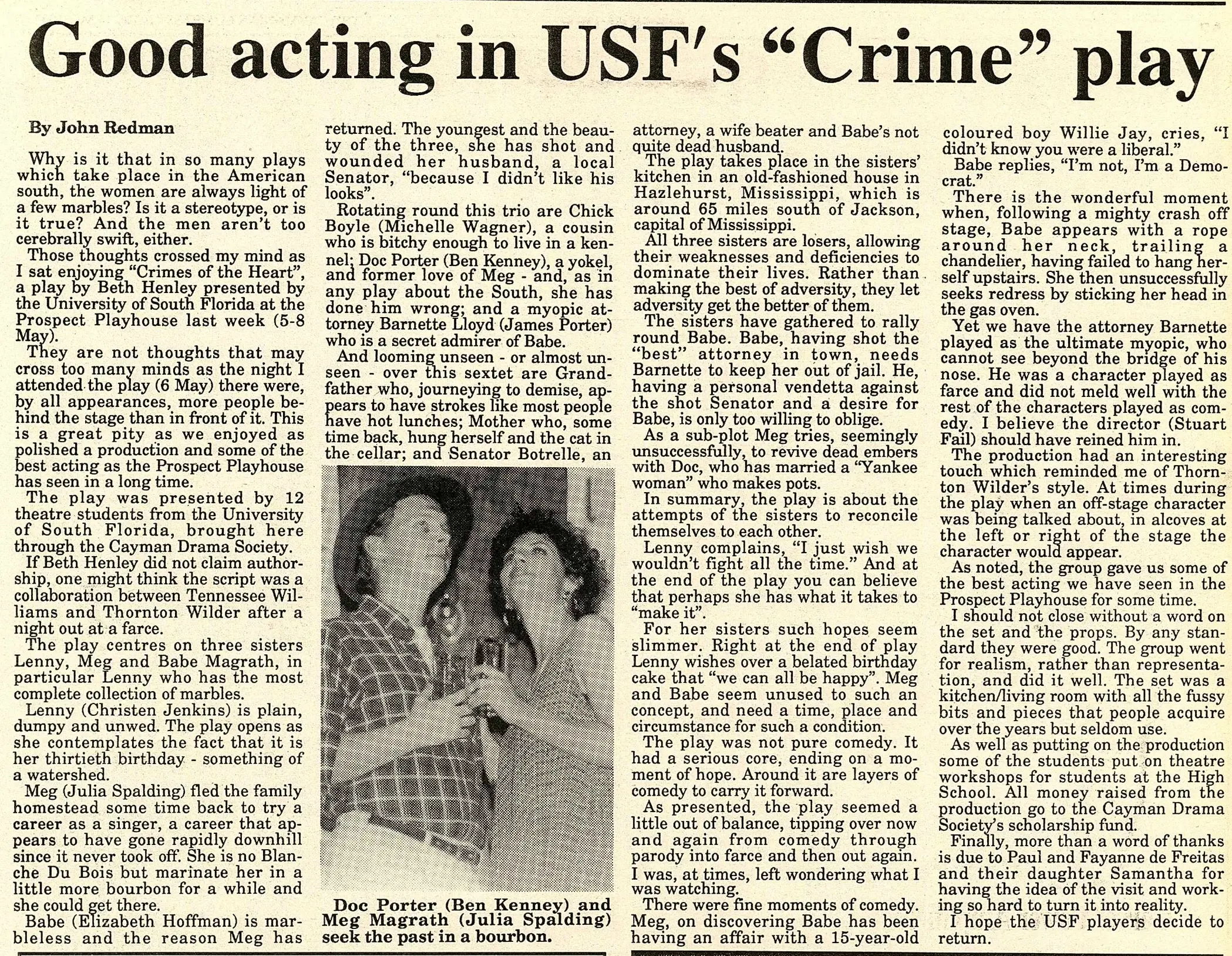
Meg (Julia Spalding) fled the family homestead some time back to try a career as a singer, a career that appears to have gone rapidly downhill since it never took off. She is no Blanche Du Bois but marinate her in a little more bourbon for a while and she could get there.
Babe (Elizabeth Hoffman) is marbleless and the reason Meg has returned. The youngest and the beauty of the three, she has shot and wounded her husband, a local Senator, "because I didn't like his looks".
Rotating round this trio are Chick Boyle (Michelle Wagner), a cousin who is bitchy enough to live in a kennel; Doc Porter (Ben Kenney), a yokel, and former love of Meg and, as in any play about the South, she has done him wrong; and a myopic attorney Barnette Lloyd (James Porter) who is a secret admirer of Babe.
And looming unseen or almost unseen over this sextet are Grandfather who, journeying to demise, appears to have strokes like most people have hot lunches; Mother who, some time back, hung herself and the cat in the cellar; and Senator Botrelle, an attorney, a wife beater and Babe's not quite dead husband.
The play takes place in the sisters' kitchen in an old-fashioned house in Hazlehurst, Mississippi, which is around 65 miles south of Jackson, capital of Mississippi.
All three sisters are losers, allowing their weaknesses and deficiencies to dominate their lives. Rather than making the best of adversity, they let adversity get the better of them.
The sisters have gathered to rally round Babe. Babe, having shot the "best" attorney in town, needs Barnette to keep her out of jail. He, having a personal vendetta against the shot Senator and a desire for Babe, is only too willing to oblige. As a sub-plot Meg tries, seemingly unsuccessfully, to revive dead embers with Doc, who has married a "Yankee woman" who makes pots.
In summary, the play is about the attempts of the sisters to reconcile themselves to each other.
Lenny complains, "I just wish we wouldn't fight all the time." And at the end of the play you can believe that perhaps she has what it takes to "make it".
For her sisters such hopes seem slimmer. Right at the end of play Lenny wishes over a belated birthday cake that "we can all be happy". Meg and Babe seem unused to such an concept, and need a time, place and circumstance for such a condition.
The play was not pure comedy. It had a serious core, ending on a moment of hope. Around it are layers of comedy to carry it forward.
As presented, the play seemed a little out of balance, tipping over now and again from comedy through parody into farce and then out again. I was, at times, left wondering what I was watching.
There were fine moments of comedy. Meg, on discovering Babe has been having an affair with a 15-year-old coloured boy Willie Jay, cries, "I didn't know you were a liberal." Babe replies, "I'm not, I'm a Democrat."
There is the wonderful moment when, following a mighty crash off stage, Babe appears with a rope around her neck, trailing a chandelier, having failed to hang herself upstairs. She then unsuccessfully seeks redress by sticking her head in the gas oven.
Yet we have the attorney Barnette played as the ultimate myopic, who cannot see beyond the bridge of his nose. He was a character played as farce and did not meld well with the rest of the characters played as comedy. I believe the director (Stuart Fail) should have reined him in.
The production had an interesting touch which reminded me of Thornton Wilder's style. At times during the play when an off-stage character was being talked about, in alcoves at the left or right of the stage the character would appear.
As noted, the group gave us some of the best acting we have seen in the Prospect Playhouse for some time.
I should not close without a word on the set and the props. By any standard they were good. The group went for realism, rather than representation, and did it well. The set was a kitchen/living room with all the fussy bits and pieces that people acquire over the years but seldom use.
As well as putting on the production some of the students put on theatre workshops for students at the High School. All money raised from the production go to the Cayman Drama Society's scholarship fund.
Finally, more than a word of thanks is due to Paul and Fayanne de Freitas and their daughter Samantha for having the idea of the visit and working so hard to turn it into reality.
I hope the USF players decide to return.