'Shakespeare's World' - flawed but
About the article
This is a digitised version of an article from The Cayman Compass's print archive. Occasionally, the digitisation process introduces transcription errors, or other problems.
See the article in its original context from April 1992.
Brought to you by

The production consisted of excerpts from eight of Shakespeare's better known plays. These were handled by four directors: Marilyn Osborn took on "Othello", "The Taming of the Shrew" and "A Midsummer Night's Dream", Tony Osborn tackled "Macbeth" and "Henry IV, Part 1", Ian Bowell directed "Merchant of Venice" and "King Lear", while Jacqueline Caunt tried her hand at "Antony and Cleopatra".
What the production needed was someone to set an overall theme to govern choice of the eight excerpts. More seriously, there was no recognition that an audience might need more than a few programme notes -- which they couldn't read in the dark, anyway -- as an introduction to a particular excerpt.
This was undoubtedly most marked in the excerpt from "Othello". This was from Act V, Scene 2, the denouement, the final scene of the play. In a full production, for four acts, tension and drama mount to culminate in the horrendous moment when Othello, wrongly suspicious of the unfaithfulness of his wife Desdemona, kills her. (Discovering the truth, he goes on to kill Iago, who has duped him, and himself.)
The audience at the Prospect Theatre, however, was suddenly presented with a gent trying to resolve himself to murder his wife. It was derisible. It didn't matter how well or how hard Peter Wootton, as Othello, acted. The audience was unready, unprimed and unprepared for it. And they laughed. It is of note that Anita Wheaton as Amelia, Desdemona's maid, showing outrage at the deed, was much more acceptable than Peter Wootton perpetrating it. Mainly, I suspect, because the audience was ready, knowing the cause of her outrage.
What the production so badly needed -- and what someone in overall control would have recognised very early on -- was an Everyman figure who would have introduced the audience to each play, could have outlined the plot that leads up to the excerpt being presented, and, perhaps, could have built up some of the dramatic tension necessary.
Everyman would also have distracted the audience from the shufflings of stage hands as they changed scenery and props. And stopped us idly wondering whether, for instance, any stage hand would notice, before the next excerpt opened, that Shylock's scales were still on stage.
One lesson that the Cayman Drama Society can learn from this production is: don't deal in plots, deal in states of mind or characters. Plots don't work.
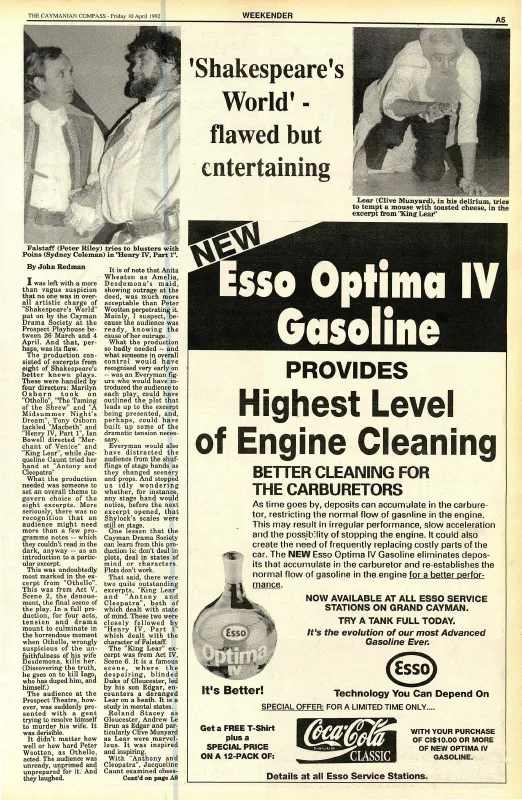
That said, there were two quite outstanding excerpts, "King Lear" and "Antony and Cleopatra", both of which dealt with state of mind. These two were closely followed by "Henry IV, Part 1" which dealt with the character of Falstaff. The "King Lear" excerpt was from Act IV, Scene 6. It is a famous scene, where the despairing, blinded Duke of Gloucester, led by his son Edgar, encounters a deranged Lear on a heath. It is a study in mental states.
Roland Stacey as Gloucester, Andrew Le Brun as Edgar and particularly Clive Munyard as Lear were marvelous. It was inspired and inspiring.
With "Anthony and Cleopatra", Jacqueline Caunt examined obses- Cont'd on page A8 from page A5
sion: Cleopatra's obsession with Antony. She took Act I, Scene 5, and to it tacked Act II, Scene 5, and a slice of Act IV, Scene 15 where Antony, having botched his suicide, dies in Cleopatra's arms.
It was not as electrifying as "Lear" but was still an engrossing piece of acting by Tricia Ranson who was suitably distracted as Cleopatra. She was ably supported by Margaret Rossiter, Marlene Riley, Roland Stacey, Peter O'Sullivan and David Spratt as court functionaries and messengers, and by Clive Munyard as a dying Antony.
The pleasing excerpt from "Henry IV, Part 1" was a vignette from Act II, Scene 4, revolving around Falstaff. The scene is a familiar slice of life: the local drunk and braggart who continues to fantasise himself into a good light on some bad dealings, no matter how much it is revealed that others know the truth.
Peter Riley was Falstaff at his blustering, bombastic best, with enough gradation to make him a character not a caricature. He was goaded suitably by Andrew Le Brun as Prince Hal and Sydney Coleman as Poins. Alan Hewitt, as Gadshill, Henry Lindo, as Bardolph, and Roland Stacey, as Peto, were suitably shamefaced as Falstaff's accomplices. In choosing to excerpt "Macbeth", it is difficult to imagine why Tony Osborn chose the opening scenes. Okay, Hilda Bodden-Fix, Marlene Riley and Margaret Rossiter had fun as the three witches, and Clive Munyard, as Macbeth, Roland Stacey, as Banquo, tried not to get caught in various coarse acting poses. But what was the point?
Clive Munyard had a gallant stab at Macbeth as a man tempted by ambition. But there is not enough there to grapple with.
If Mr. Osborn must do "Macbeth", there are better scenes for a vignette. One that spring's readily to mind is Lady Macbeth's sleep walking scene for its portrayal of a woman wracked with guilt. Or maybe Act I, Scene 7, where Macbeth, goaded by Lady Macbeth, tries to steel himself to kill Duncan.
Scenes from "The Merchant of Venice" can be something of a problem on their own because of their seeming anti-Semitic content. Without the full play to give us the various shades of the plot, it needed an Everyman to give some background. The extract was the well-known trial scene (Act IV, Scene I) with Portia disguised as a lawyer.
As played, it came over as London East End schmatter merchant and money lender Shylock (Alan Hewitt) having a spot of bother with the local traders' association, most of whom behaved like likely candidates for the National Front or Sir Oswald Moseley's brown shirts. In particular Gratiano (Peter Riley) seemed to await a local Kristalnacht.
We badly needed some explanation of what made Shylock seek revenge: Having been spurned, kicked and spat upon for most of his life, why should Shylock not seek revenge. "If you pick us, do we not bleed? If you tickle us, do we not laugh? If you poison us, do we not die? And if you wrong us, shall we not revenge?" he asks in Act III, Scene 1. Indeed, recent professional productions of the play have made Shylock a much more sympathetic character.
Bernie Sampson had an interesting interpretation of Portia, playing her along the lines of a liberal social worker trying to make all sides see reason. The well-known "quality of mercy" speech was refreshingly presented as an argument for reasonableness all round, rather than a declamation for mercy and justice.
Two of the directors, Ian Bowell (Petruchio) and Jacqueline Caunt (Kate), got together to be directed by a third, Marilyn Osborn, for the excerpt from "The Taming of the Shrew". The excerpt was part of Act II, Scene 1, where Kate meets Petruchio for the first time.
Once again a little more explanation might have been valuable. We needed reminding that Petruchio, a gent from Verona, has decided that marrying wealth is a better bet that earning it, and that he is prepared to marry pretty much anyone as long as she is wealth. In Act I, Scene 2, he has said, provided she is wealth enough, he does not care how foul she is, how old she is, how cursed or shrewd she is, or how rough she is. It explains why he seems unwilling to take a surly "Get lost" from a wilful Kate.
But in the end, why do the scene in the first place? Which is also the question I might ask about the scenes from "A Midsummer Night's Dream".
The excerpt was part of Act I, Scene 1, involving humans Helena (Valerie Cottier) Hermia (Jane Jones) and Lysander (Alan Hewitt), and Act II, Scene 1, involving the fairy queen Titania (Gabrielle Wheaton), the fairy king Oberon (Nigel Girdlestone), and Oberon's Puck (Nicola Moore) and Titania's fairy (Davina Dennis). Just why these two scene were tacked together was not obvious. In the play there is a scene involving the comedy team of Bottom, Quince, Snug, Flute, Snout and Starveling separating the two.
The fairies were interesting: Titania was suitable proud, if not regal, imperious, dominating even nagging and decidedly nonethereal. Oberon was peevish, definitely cowed. I wondered he had ever dared to step out of line, without permission.
All here had problems to a greater or lesser extent with Shakespeare's couplets, letting rhyme dominate over meaning. The backstage crew deserve a word of commendation for the sets, which were simple yet effective. They also need a bigger thunder sheet. It was an entertaining evening, but that is not enough. Shakespeare's genius lies in his ability to examine and explain the human condition.
As to the the CDS chairman's claim that it was the first time the Society has presented Shakespeare, well it was and it wasn't. Back in 1974 the Society presented in an evening's entertainment a one-act play "The Rehearsal", which concerned a rehearsal of "Macbeth". The author borrowed heavily from the Bard.