Jack and the Beanstalk: ...a “different” kind of an evening
About the article
This is a digitised version of an article from The Cayman Compass's print archive. Occasionally, the digitisation process introduces transcription errors, or other problems.
See the article in its original context from January 1981.
Brought to you by

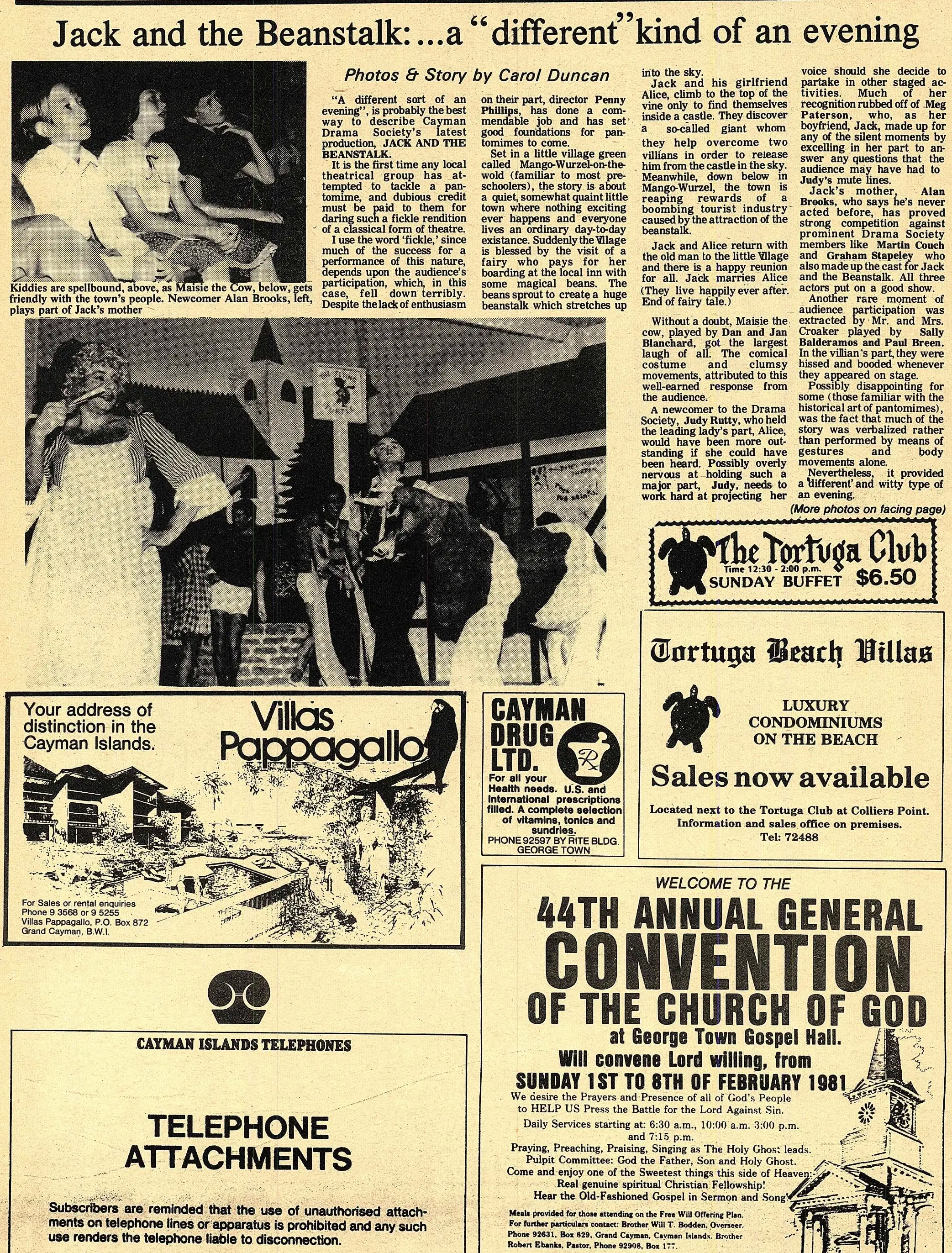
It is the first time any local theatrical group has attempted to tackle a pantomime, and dubious credit must be paid to them for daring such a fickle rendition of a classical form of theatre.
I use the word 'fickle,' since much of the success for a performance of this nature, depends upon the audience's participation, which, in this case, fell down terribly. Despite the lack of enthusiasm on their part, director Penny Phillips, has done a commendable job and has set good foundations for pantomimes to come.
Set in a little village green called Mango-Wurzel-on-thewold (familiar to most preschoolers), the story is about a quiet, somewhat quaint little town where nothing exciting ever happens and everyone lives an ordinary day-to-day existance. Suddenly the Vllage is blessed by the visit of a fairy who pays for her boarding at the local inn with some magical beans. The beans sprout to create a huge beanstalk which stretches up into the sky.
Jack and his girlfriend Alice, climb to the top of the vine only to find themselves inside a castle. They discover a so-called giant whom they help overcome two villians in order to release him from the castle in the sky.
Meanwhile, down below in Mango-Wurzel, the town is reaping rewards of a boombing tourist industry caused by the attraction of the beanstalk. Jack and Alice return with the old man to the little Village and there is a happy reunion for all. Jack marries Alice (They live happily ever after. End of fairy tale.) Without a doubt, Maisie the cow, played by Dan and Jan Blanchard, got the largest laugh of all. The comical costume and clumsy movements, attributed to this well-earned response from the audience.
A newcomer to the Drama Society, Judy Rutty, who held the leading lady's part, Alice, would have been more outstanding if she could have been heard. Possibly overly nervous at holding such a major part, Judy, needs to work hard at projecting her voice should she decide to partake in other staged activities. Much of her recognition rubbed off of Meg Paterson, who, as her boyfriend, Jack, made up for any of the silent moments by excelling in her part to answer any questions that the audience may have had to Judy's mute lines.
Jack's mother, Alan Brooks, who says he's never acted before, has proved strong competition against prominent Drama Society members like Martin Couch and Graham Stapeley who also made up the cast for Jack and the Beanstalk. All three actors put on a good show.
Another rare moment of audience participation was extracted by Mr. and Mrs. Croaker played by Sally Balderamos and Paul Breen. In the villian's part, they were hissed and booded whenever they appeared on stage.
Possibly disappointing for some (those familiar with the historical art of pantomimes), was the fact that much of the story was verbalized rather than performed by means of gestures and body movements alone.
Nevertheless, it provided a 'different' and witty type of an evening.
(More photos on facing page)