The night the critics stole a Drama Society production
About the article
This is a digitised version of an article from The Cayman Compass's print archive. Occasionally, the digitisation process introduces transcription errors, or other problems.
See the article in its original context from June 1979.
Brought to you by

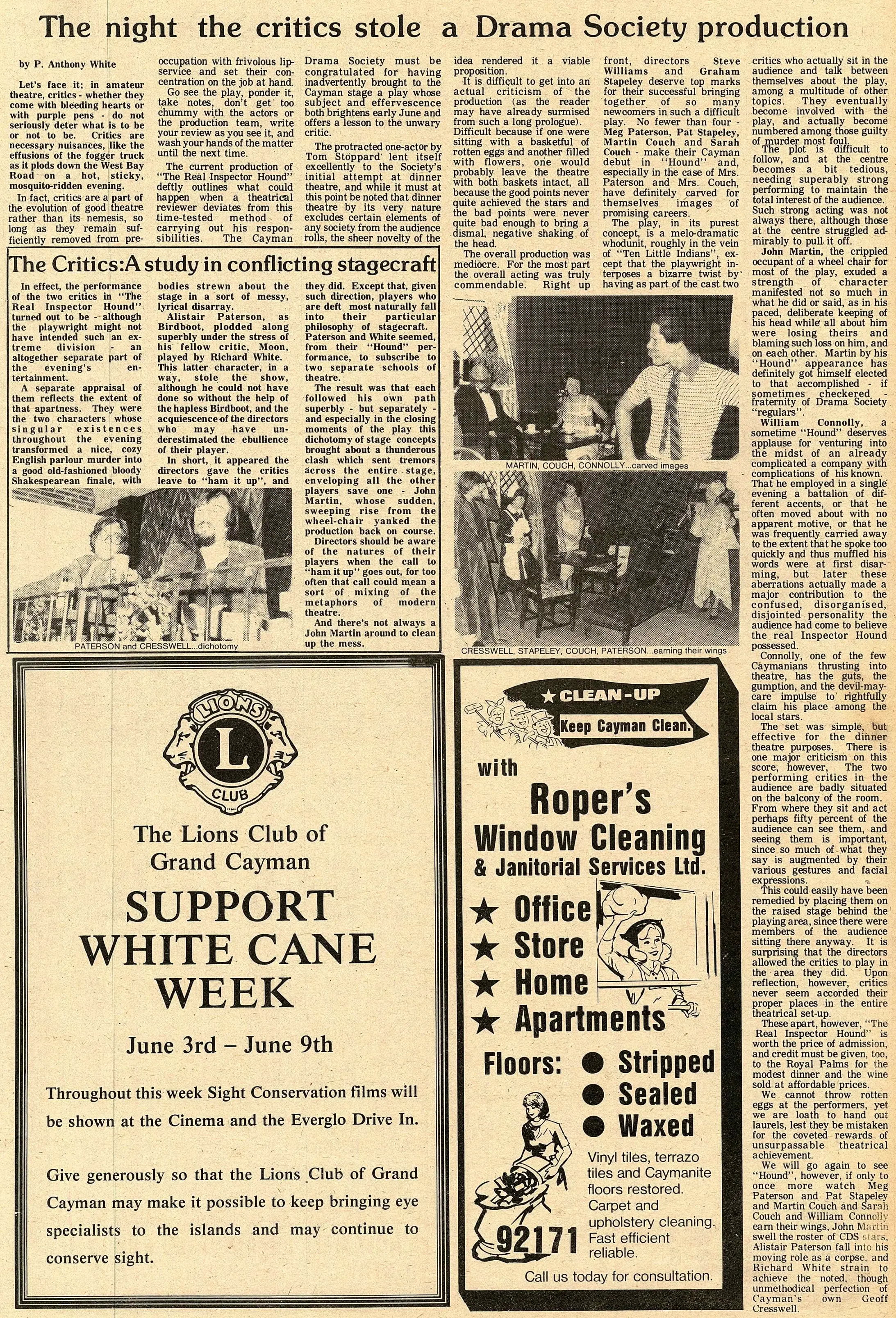
In fact, critics are a part of the evolution of good theatre rather than its nemesis, so long as they remain sufficiently removed from preoccupation with frivolous lipservice and set their concentration on the job at hand.
Go see the play, ponder it, take notes, don't get too chummy with the actors or the production team, write your review as you see it, and wash your hands of the matter until the next time. The current production of "The Real Inspector Hound" deftly outlines what could happen when a theatrical reviewer deviates from this time-tested method of carrying out his responsibilities. The Cayman Drama Society must be congratulated for having inadvertently brought to the Cayman stage a play whose subject and effervescence both brightens early June and offers a lesson to the unwary critic. The protracted one-actor by Tom Stoppard' lent itself excellently to the Society's initial attempt at dinner theatre, and while it must at this point be noted that dinner theatre by its very nature excludes certain elements of any society from the audience rolls, the sheer novelty of the idea rendered it a viable proposition.
It is difficult to get into an actual criticism of the production (as the reader may have already surmised from such a long prologue). Difficult because if one were sitting with a basketful of rotten eggs and another filled with flowers, one would probably leave the theatre with both baskets intact, all because the good points never quite achieved the stars and the bad points were never quite bad enough to bring a dismal, negative shaking of the head.
The overall production was mediocre. For the most part the overall acting was truly commendable. Right up front, directors Steve Williams and Graham Stapeley deserve top marks for their successful bringing together of so many newcomers in such a difficult play. No fewer than four - Meg Paterson, Pat Stapeley, Martin Couch and Sarah Couch make their Cayman debut in "Hound" and, especially in the case of Mrs. Paterson and Mrs. Couch, have definitely carved for themselves images of promising careers.
The play, in its purest concept, is a melodramatic whodunit, roughly in the vein of "Ten Little Indians", except that the playwright interposes a bizarre twist by having as part of the cast two critics who actually sit in the audience and talk between themselves about the play, among a multitude of other topics. They eventually become involved with the play, and actually become numbered among those guilty of murder most foul.
The plot is difficult to follow, and at the centre becomes a bit tedious, needing superably strong performing to maintain the total interest of the audience. Such strong acting was not always there, although those at the centre struggled admirably to pull it off.
John Martin, the crippled occupant of a wheel chair for most of the play, exuded a strength of character manifested not so much in what he did or said, as in his paced, deliberate keeping of his head while all about him were losing theirs and blaming such loss on him, and on each other. Martin by his "Hound" appearance has definitely got himself elected to that accomplished - if sometimes checkered - fraternity of Drama Society "regulars".
William Connolly, a sometime "Hound" deserves applause for venturing into the midst of an already complicated a company with complications of his known. That he employed in a single evening a battalion of different accents, or that he often moved about with no apparent motive, or that he was frequently carried away to the extent that he spoke too quickly and thus muffled his words were at first disarming, but later these aberrations actually made a major contribution to the confused, disorganised, disjointed personality the audience had come to believe the real Inspector Hound possessed.
Connolly, one of the few Caymanians thrusting into theatre, has the guts, the gumption, and the devil-may-care impulse to rightfully claim his place among the local stars.
The set was simple, but effective for the dinner theatre purposes. There is one major criticism on this score, however, The two performing critics in the audience are badly situated on the balcony of the room. From where they sit and act perhaps fifty percent of the audience can see them, and seeing them is important, since so much of what they say is augmented by their various gestures and facial expressions.
This could easily have been remedied by placing them on the raised stage behind the playing area, since there were members of the audience sitting there anyway. It is surprising that the directors allowed the critics to play in the area they did. Upon reflection, however, critics never seem accorded their proper places in the entire theatrical set-up.
These apart, however, "The Real Inspector Hound" is worth the price of admission, and credit must be given, too, to the Royal Palms for the modest dinner and the wine sold at affordable prices.
We cannot throw rotten eggs at the performers, yet we are loath to hand out laurels, lest they be mistaken for the coveted rewards of unsurpassable theatrical achievement.
We will go again to see "Hound", however, if only to once more watch Meg Paterson and Pat Stapeley and Martin Couch and Sarah Couch and William Connolly earn their wings, John Martin swell the roster of CDS stars, Alistair Paterson fall into his moving role as a corpse, and Richard White strain to achieve the noted, though unmethodical perfection of Cayman's own Geoff Cresswell.