The stars and stripes of Ten Little Indians
About the article
This is a digitised version of an article from The Cayman Compass's print archive. Occasionally, the digitisation process introduces transcription errors, or other problems.
See the article in its original context from September 1977.
Brought to you by

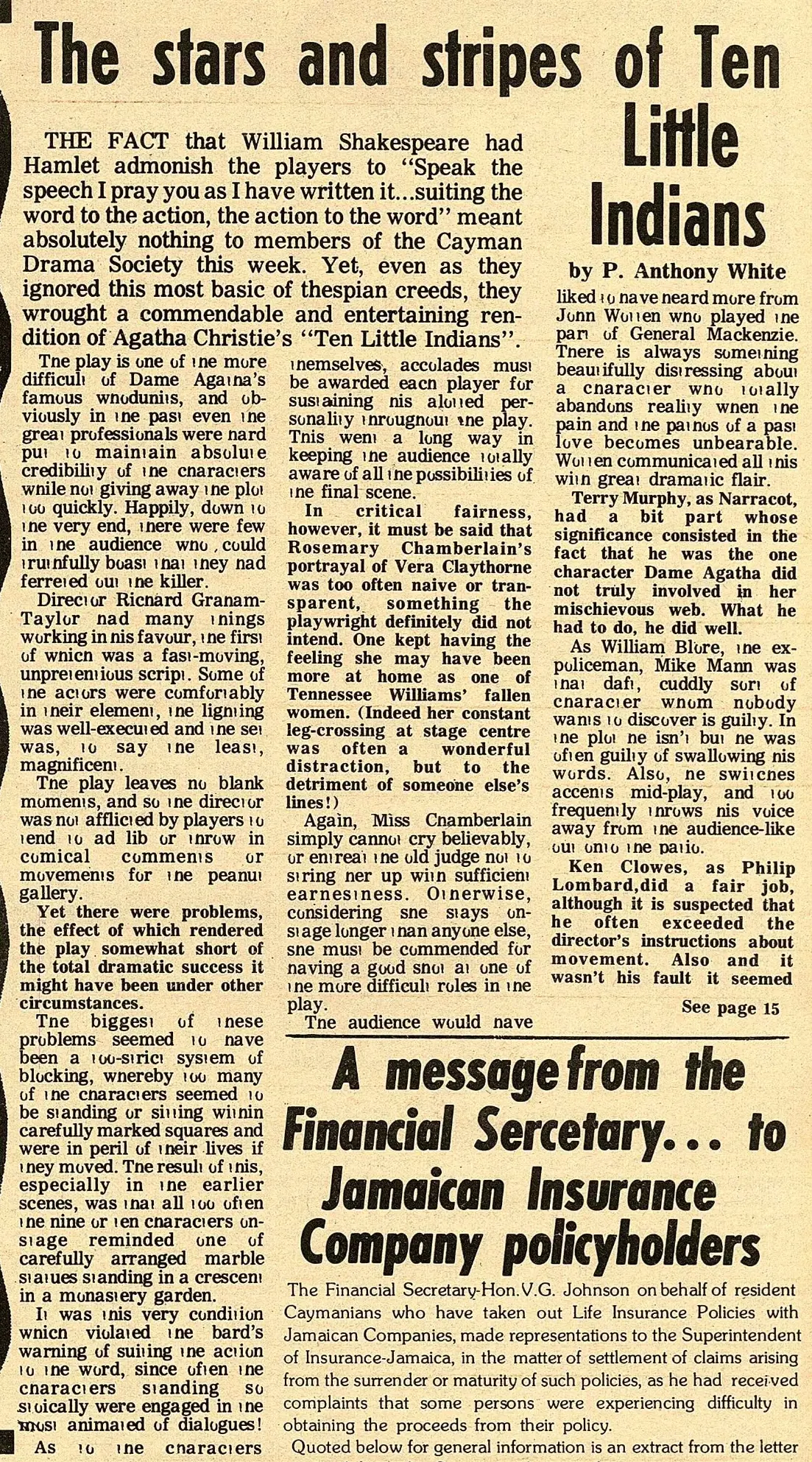
The play is one of the more difficult of Dame Againa's famous whodunits, and obviously in the past even the great professionals were nard put to maintain absolute credibility of the characters while not giving away the plot too quickly. Happily, down to the very end, there were few in the audience who could runfully boast that they had ferreted out the killer. Director Richard Granam-Taylor had many things working in his favour, the first of which was a fast-moving, unpretentious script. Some of the actors were comfortably in their element, the lighting was well-executed and the set was, to say the least, magnificent.
The play leaves no blank moments, and so the director was not afflicted by players to tend to ad lib or throw in comical comments or movements for the peanut gallery.
Yet there were problems, the effect of which rendered the play somewhat short of the total dramatic success it might have been under other circumstances.
themselves, accolades must be awarded each player for sustaining his aloned personality throughout the play. This went a long way in keeping the audience totally aware of all the possibilities of the final scene.
In critical fairness, however, it must be said that Rosemary Chamberlain's portrayal of Vera Claythorne was too often naive or transparent, something the playwright definitely did not intend. One kept having the feeling she may have been more at home as one of Tennessee Williams' fallen women. (Indeed her constant leg-crossing at stage centre was often a wonderful distraction, but to the detriment of someone else's lines!)
Again, Miss Chamberlain simply cannot cry believably, or entreat the old judge not to string her up win sufficien earnestness. Otherwise, considering she stays onstage longer than anyone else, she must be commended for having a good shot at one of the more difficult roles in the play. themselves, accolades must be awarded each player for sustaining his aloned personality throughout the play. This went a long way in keeping the audience totally aware of all the possibilities of the final scene.
In critical fairness, however, it must be said that Rosemary Chamberlain's portrayal of Vera Claythorne was too often naive or transparent, something the playwright definitely did not intend. One kept having the feeling she may have been more at home as one of Tennessee Williams' fallen women. (Indeed her constant leg-crossing at stage centre was often a wonderful distraction, but to the detriment of someone else's lines!)
Again, Miss Chamberlain simply cannot cry believably, or entreat the old judge not to string her up with sufficient earnestness. Otherwise, considering she stays onstage longer than anyone else, she must be commended for having a good shot at one of the more difficult roles in the play. The biggest of nese problems seemed to nave been a 100-strict system of blocking, whereby 100 many of the characters seemed to be standing or sitting within carefully marked squares and were in peril of their lives if they moved. The result of this, especially in the earlier scenes, was that all too often the nine or ten characters onstage reminded one of carefully arranged marble statues standing in a crescent in a monastery garden.
It was this very condition which violated the bard's warning of suiting the action to the word, since often the characters standing so stoically were engaged in the most animated of dialogues!
As to the characters The audience would have liked to have heard more from Jonn Wonen who played the part of General Mackenzie. There is always something beautifully distressing about a character who totally abandons reality when the pain and the painos of a past love becomes unbearable. Wonen communicated all this with great dramatic flair.
Terry Murphy, as Narracot, had a bit part whose significance consisted in the fact that he was the one character Dame Agatha did not truly involved in her mischievous web. What he had to do, he did well.
As William Blore, the ex-policeman, Mike Mann was in a daft, cuddly sort of character whom nobody wants to discover is guilty. In the plot he isn't but he was often guilty of swallowing his words. Also, he switches accents mid-play, and too frequently throws his voice away from the audience-like out onto the patio.
Ken Clowes, as Philip Lombard, did a fair job, although it is suspected that he often exceeded the director's instructions about movement. Also and it wasn't his fault it seemed CAYMAN FREE
PRESS LIMITED
TELEPHONES: 92131 92132 92662 strange that when he and Rogers come in out of the rain Rogers seems drenched and Lombard bone dry. A small point, but as noticeable as the entrance of a player from a door through which he could not have conceivably enter if one is faithful to the plot. In his first appearance on stage, Michael Marshall, as Dr. Armstrong, was good enough to maintain the quality of a doctor who had made a drunken mistake in an operation earlier and who was now fully repentant, but yet didn't overplay the goody-goody bit to the point where he could be immediately eliminated as the killer.
His actions were strained at moments when he could well have relaxed a bit, however. Robyn Kalweit, as the frumpish Emily Brent, was remarkable in her portrayal, and except for some confusion about the skein of wool which appeared miraculously from her purse, she must be given full honours.
Stuart Hursi and Angela Cricnon are good in the roles of Mr. and Mrs. Rogers, especially when he pathetically announces, after his wife's death, that he's no good in the kitchen.
It was perhaps at this point that the audience marked him off as a possible killer. Nick Press, as Anthony Marston, was good comic relief while he lasted. He was obviously no stranger to the stage, and could very effectively resist the temptation to be more overbearing in offering to drive Vera Claythorne home once they reached the mainland. The snow, however, belonged to Michael Parker. He was brilliant as Sir Lawrence Wargrave, and most of the other players seemed to take their dramatic cues from him. More than any other player he understood the immensity of his role, and executed that role with an ordered, sustained interest and credibility a credibility which, in the final scene, made "Ten Little Indians" a truly delightful effort by the Cayman Drama Society.
While the entire cast is, strictly speaking, amateur, there were some sparks of professionalism, which is always a rewarding feature of amateur productions. Those who are, so to speak, veterans of the Cayman stage, were very careful not to upstage the amateurs. It was done not patronisingly, but with the true theatre knowledge that a play, as a chain, is only as sturdy as its weakest actor.
Richard Graham-Taylor assumed a task which called for razor-edged direction. He discovered success, and the Cayman Drama Society has discovered, among ten little indians, a directing star!